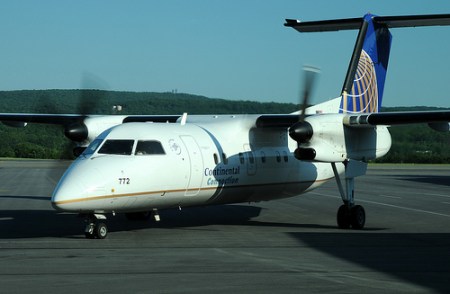
 The tragic accident of the Continental Airlines Dash 8 has generated a lot of speculation about the role of ice in the loss of control and subsequent crash of the aircraft. I am not going to suggest any cause of the accident as there are many knowledgeable people involved in the investigation that will come up with the answers.
I would like to explain to those who are interested, why ice makes such a difference in the handling of the aircraft. To understand the problem you have to have an idea of the theory of aircraft flight.
The wings have a shape which produces lift as they travel through the air. However, they also produce drag and they have a weight that is a gravitational force. The weight of the wing acts through the centre of gravity; this is the point that the wing would balance on if it were removed from the plane. The centre of lift is where all the lift forces could be measured and opposes and is normally behind the center of gravity. Because it is behind the centre of gravity there is a twisting force to lower the front of the wing. If this were not opposed then the aircraft would not be able to fly.
The tail is the place where the opposition is generated. The tail surfaces are designed to generate a downward force to oppose the twisting force of the wing and keep the aircraft level. So, everything is in balance. There are times when more lift is required, for the aircraft to take off or fly slower so it can land. To achieve this flaps on the back of the wing can be lowered to increase the size of the wing and produce more lift.
When the flaps are lowered the centre of lift moves rearwards and the twisting force of the wing increases, this is normally opposed by moving the trim on the tail to increase the opposition force and raise the nose. There is a range of trim available which is sufficient for normal operation.
This is the way the aircraft is designed to operate. When ice collects on the wings it changes the shape of the wing so that some of the lift is lost, it also increases the weight of the wing which can move the center of gravity forward. The build up of ice on the tail will add even more weight to the aircraft and reduce its ability to oppose the twisting force on the wing. The result is the same as lowering the flaps without the added lift that would be generated. The nose would be lowered and the way to deal with this would be to trim the tail to increase the downward force.
This is exactly what the autopilot does. As the ice builds up on the wings and tail the autopilot trims the tail to increase the downward force. This can be a very slow and insidious process as the autopilot will use more trim to keep the aircraft level. If the crew are not aware of the situation they may find that the trim limit has been reached before they know they have a problem. If they then change the status quo by lowering the landing gear or the flaps the auto pilot will be unable to trim the aircraft and will disengage leaving the crew with a very dangerous nose down attitude for which instant recognition of the problem and the correct response will be needed to avoid a loss of control.
This situation is normally also at low altitude and airspeed and is very hazardous. Most operators regard icing very seriously and when in icing normally instruct the crew to fly the plane manually to make them aware at an early stage of the amount of trim they are using to control the attitude. They can then decide if they need to climb out of the icing conditions or take other action to avoid increasing ice build up. There are different systems on different aircraft which either prevent ice forming (anti-icing) or remove it as it forms (de-icing). De-icing that uses air to inflate boots to distort the leading edge of the wing and break up the ice which has formed was the system on the Dash 8 in Buffalo. This system requires the ice be allowed to build up to a certain thickness before the boots are inflated as thin ice will not break off. An automatic timer will inflate the boots periodically and there is a manual system if the automatic periods are too long.
The tragic loss of the aircraft in Buffalo has brought the problem of icing into the spotlight but aircrews and airplanes have been dealing with it ever since flying began and there are many safeguards built into the system. I hope this has shed some insight on the hazards of ice on aircraft and the means to combat it.
 Aircraft News Weblog