Tag: boeing

  • Singapore Airlines B777 Fire on Landing

    Singapore Airlines Flt SQ368 to Milan returned to Singapore Changi airport after a low oil indication on the right hand engine. The crew handled the return by the book and the aircraft landed with no issues and to a round of applause from the 222 passengers on board. However, the applause was short lived as it became apparent the right hand wing was fully engulfed in flames. Remarkably the passengers and crew remained on board and calmly waited for the emergency services to extinguish the flames before disembarking via a set of steps! This would not have been believable in a work of fiction but there a videos from the aircraft passengers who passed the time recording the event through the aircraft windows. Kudos to them and the crew for not rushing into an uncertain mass evacuation and possible injury at the first sign of danger. I can  only assume the crew were following the instructions of the emergency services to remain on board. The following is a media release from the Civil Aviation Authority of Singapore. 

    Media Release

    27 Jun 2016

    CAAS Media Statement on Singapore Airlines (SQ368) Incident

    Early this morning, SQ368, a Singapore Airlines (SIA) B777 aircraft bound for Milan, chose to return to Singapore as the indicator for its right engine had shown oil loss.
    Shortly after landing, a fire was observed to have occurred in the vicinity of the aircraft’s right engine. Changi’s Airport Emergency Service, which was already on standby, responded promptly and the fire was extinguished within 5 minutes. SATS also contributed to ensuring the safety of the passengers and flight crew. No one was hurt during the incident.
    The runway on which the aircraft landed was closed for about 5 hours for repairs and clean-up. Landings and take-offs continued on the other runway. Whilst some flights were impacted, all flights were able to take off within one hour of their scheduled departure times.  
    CAAS will be investigating to determine the causes of the incident. The Ministry of Transport’s Air Accident Investigation Bureau will also be conducting an independent investigation.  
  • Asiana Airlines Boeing 777 crash at San Francisco

    There is a lot of information and conjecture coming out in the press regarding the reason the Boeing 777 hit the sea wall during the attempted landing at San Francisco. There will be a definite answer from the NTSB when the investigation is completed which could take months to finalize. Regardless of any mechanical or electronic failures in the aircraft that may have contributed to the crash, the investigation will consider the Human Factors involved. There are always human factors involved and they go well beyond the crew and the circumstances of this particular flight.

    The NTSB will construct a timeline for each crew member going back at least 72 hours. This will include all rest and work periods, medications or personal events which could influence concentration or mood. Crew interaction will be examined to ensure the appropriate actions were not affected by personalities in the cockpit. There will be an examination of the distractions and circumstances in regard to the approach into the airport, and also any distraction warnings or unusual circumstances within the aircraft during the flight.

    It seems to be common knowledge that there was training taking place in the cockpit during the flight. Training of the ‘pilot flying’ during the approach to San Francisco will be examined to assess the amount of supervision provided by the training Captain. This is particularly important as the responsibility to maintain the safety parameters lies with the training Captain if there is a departure from Standard Operating Procedures or erosion of safety limits.

    The reasons for this crash will be many and varied as the Human Factors reach into all aspects of the Asiana Airlines operation of the aircraft in their fleet. The reason could cross all types of aircraft and operations so lessons will be learned and changes and improvements made to prevent this type of accident occurring again in all airlines and operators.

  • Boeing and Airbus on track?

    The Boeing Dreamliner is back in the air and the Airbus A350 is completing the first elements of the flight test program required for certification. So all is well in the Big Two manufacturers world. Or is it, such is the nature of the business that this assumption will never be accurate. There will always be setbacks and problems when each airframe, engine combination is pushing back the boundaries of fuel economy and efficiency.

    There is a huge requirement to reduce all the negatives like fuel burn and aircraft weight while increasing the load and range of the aircraft. The development of the airliner design from the first jet airliner, the De Havilland Comet, to the latest Boeing or Airbus aircraft has been amazing in the last 60 years. Every time I think they have reached the ultimate in design they exceed it with the next aircraft.

    The Boeing 737 was, and still is the work horse of the Seattle based manufacturer. It was challenged by the A320 family and now the Big Two are competing for another prize with the 787 and A350 by flying non stop from London England to Sydney Australia as a regular commercial route.

    Quite amazing that Louis Bleriot managed the first powered flight across the English Channel in 1909 and now in 2013 we are vying for non stop scheduled flights from London to Sydney.

    I can’t wait to see what they will come up with next.

  • Airbus A350-900

    A350-900

    Airbus are reporting there will be no delay to the production and testing schedule of the A350 due to the problems with Lithium-Ion (Li-on) batteries.

    While Boeing are searching for a solution with the B787 Dreamliner battery problems Airbus are pressing ahead with then A350 and have replaced the planned Li-on batteries in favour of the more common Ni-Cad type.There are a number of problems with being the ‘first’ to use new technology and Boeing have taken on the brunt of the problems with the Dreamliner.

    Airbus have been developing their own twin engined wide bodied challenger to the B777 and B787 in the A350. This is the first step into the new technology of extensive carbon fibre for Airbus who are using it as the main component in the fuselage and the wings. This will allow a fuel saving to compete with Boeing on the non stop long distance routes from Europe to Australia and New Zealand.

    Although I would need a good vacation after a London to Sydney 19 hour non stop flight. It is amazing that Bleriot only managed the first crossing of the English Channel in an aircraft from England to France in 1909, around 25 miles, and in 1989 a Qantas B747 completed a non stop flight from London to Sydney 10,500 miles as a publicity stunt.

    Something that would not have helped Bleriot is the engine developed for the A350, which weighing in at just over 6 tonnes would have been bit much for his aircraft!

    The Trent XWB-84 has completed all certification and is being shipped to Toulouse from Rolls Royce for installation. This engine will produce up to 84,000 lbs of thrust required for the first A350-900 which will be completing the flight testing of the aircraft design. Changes to the thrust of the engine will power the other two variants of the aircraft. The increased thrust for the A350-1000 will be achieved by increasing the core engine power, temperature and fan speed rather than the diameter of the engine. Due to this approach nearly 80% of the line replacement units will be common to the engine variants.

    The A350 is scheduled to start flight testing this summer and for those who would like to keep informed of developments here is a link http://www.a350xwb.com/#

  • Dreamliner

    The Boeing 787 Dreamliner has had a most unfortunate couple of weeks. There has been the worst publicity that any aircraft could have. An inflight fire or smoke in the cabin are the worst case scenario for aircrew and the public when it comes to air travel.

    I have avoided the temptation to jump on the band wagon as I have had the experience of working on an newly introduced aircraft type. There is no test like the daily operation of an aircraft, or any vehicle, to bring out a number of problems that the designer and regulatory authorities have not thought of. The Dreamliner has taken this to a whole new level with the type of problem and the world wide grounding of the fleet. If that wasn’t bad enough then the timeline of not only the fix but understanding the cause is seeing the confidence of the carriers fade away.

    There is only so much that the airlines can put up with before the shareholders make the decision to abandon the aircraft and look elsewhere in the competitive world of aircraft supply. Not only that but all the time the airlines are not flying the Dreamliner’s they already operate, the bills are piling up and the lawyers are lining up.

    The battery on the aircraft is touted as the source of the problem,which is ironic as it is there to solve problems when the normal power generation is not operating. This is not the first time this type of battery has given trouble. Cessna had them removed from the new Citation. In that case there was an off the shelf replacement which they could switch to. But it is my understanding that the Dreamliner batteries are so specific to the aircraft that a replacement is not possible in the short term. The whole aircraft is such a new concept that they are breaking ground in many aspects of the systems on board.

    I love the innovation and cutting edge development. But I think they had too much faith put into the battery type without a ‘plan B’. Lets hope the investigation comes to a successful conclusion soon for the sake of the company and the travelling public.

  • Boeing 777 Trent engine problems with ice.

    The US Federal Aviation Authority have now issued an Airworthiness Directive (AD) concerning the problems with ice in the fuel system of Boeing 777-200 and 300 airplanes fitted with Rolls Royce Trent 800 engines. The AD requires the crew to monitor the fuel temperature within 3 hours of top of descent and if it is below a certain temperature they must increase the engine power to prevent the formation of ice in the main tank fuel supply system. They can do this by stepping up to a higher altitude or increase the airspeed. There is no requirement to carry out this procedure if the aircraft is not fitted with Trent 800 engines.

    There is also a procedure for the circulation of the fuel on the ground by a certified mechanic to prevent the formation of ice.

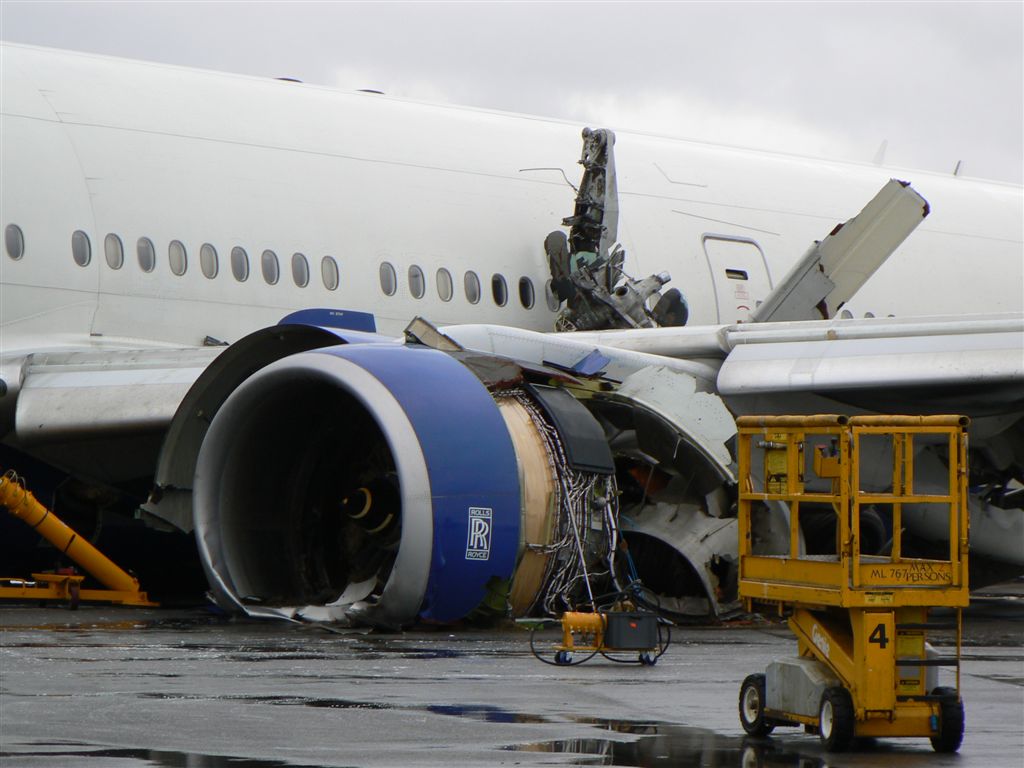
    This AD is a result of the problems encountered in January 2008 by a British Airways Boeing 777 which failed to respond to a command for increased thrust while the aircraft was on approach to London Heathrow airport and landed short of the runway. The interim report suggested ice formed in the main fuel tank supply system during low fuel flow conditions in cruise flight. The ice then dislodged and caused a restriction in the fuel supply because of high flow conditions due to the lower altitude during approach.

    No doubt there will be more measures to prevent the formation of ice from the engine and aircraft manufacturers but in the mean time the FAA are counting on this procedure to prevent the recurrence of the fuel restriction and loss of engine power.

  • British Airways Boeing 777 Crash at Heathrow – Report

    Ice has always been the enemy of aircraft, it builds up on the wings and reduces lift and it lies on the runway and reduces braking and directional control when landing, but now there is a new hazard. After nine months of investigation the Air Accidents Investigation Branch (AAIB) have decided the cause of the British Airways Boeing 777 landing short at Heathrow and crashing was due to ice in the fuel. All the passengers and crew escaped the aircraft with only minor injuries apart from one man who broke his leg.

    It has been known for years that there is water in aviation fuel and when the temperature drops, due to the aircraft operating at altitude, ice crystals form in the fuel. There have been chemical and mechanical solutions to this problem and it is a largely unknown problem in large commercial aircraft.

    The fuel passing through a Trent 800 engine like the one that was powering the BA aircraft goes to an oil/fuel heater in the engine fuel system. This takes hot oil from the engine to a matrix of small pipes and passes fuel around the pipes on its way to the fuel control unit and the burners. This is normally sufficient to melt any ice that may be in the fuel so it will not interfere with the operation of the engine. The theory of the investigators is that ice formed before the engine oil/fuel heater and reduced the amount of fuel available for the engines to use.

    The High Pressure fuel pumps that are downstream of the oil/fuel heater showed evidence of cavitation. This is a condition that happens when the impellor of the pump has an insufficient fuel supply to boost to a higher pressure and mechanical damage is caused to the pumps. Clearly there was low fuel supply to the engines but where was the restriction? Because of filters, low-pressure pumps and valves that are all in the fuel supply system it has not yet been determined as to where the problem lies.

    Why it occurred is also a mystery as there has never been a case of fuel starvation due to icing in the fuel system of a commercial airliner. The Flight Data Recorder has shown that within 6 seconds both engines reduced power to a value below that needed to maintain flight and the automatic systems and the pilots took the required actions to supply more fuel but to no avail as it could not get to the High Pressure Pump.

    The low fuel flow at cruise power settings on an especially cold, long flight may have caused a build up of ice in an area in the fuel system which, with the high fuel demand in the landing phase of flight, detached from its location and caused the restriction. This theory has not yet been proven despite extensive and imaginative testing. The reason it is being put forward is every other scenario has been eliminated. As this is a preliminary report we will have to wait some time, maybe years, before the final report is issued and the cause is known. In the mean time the FAA and the manufacturers of the engine and aircraft are going to look at ways to mitigate the effects of long, cold flights on the fuel system.