Tag: aircraft

  • Q400 Landing Gear Collapse: Causes and Impact

    A Q400 aircraft landing at Halifax International Airport in Nova Scotia suffered a landing gear collapse after an uneventful flight. The Transportation Safety Board initial report found that the aircraft had a tire failure on takeoff. Upon landing, the tire remnants started rotating. This caused enough vibration for the main landing gear to unlock and collapse.

    When the propeller contacted the runway the blades broke off and the engine was badly damaged. The aircrew declared a Mayday and secured the aircraft for an emergency evacuation on the runway. All passengers and crew successfully left the aircraft with no serious injuries.

    As the investigation continues I would like to describe the configuration of the landing gear on the Q400. On the Down selection, the gear doors open. The main landing gear is hydraulically lowered aft from the engine nacelle. The Actuator linkage travels overcenter and locks, the landing gear doors then close again. It is held in the down position by hydraulic pressure and large springs.

    The Q400 is over 25 years old and is no longer in production. It is operated all over the world and has proven to be a reliable aircraft. The failure of the landing gear due to tire remnants vibration is not a new problem. It is unlikely the investigation will call for major modifications as a solution to this accident.

  • PW1100G Geared Turbo Fan

    Pratt and Whitney have found themselves in a strange situation. Their order book is brimming with orders for the PW1100G ( Geared Turbo Fan) but the engine used in the Airbus 320/321 Neo is being removed in record numbers for repair. In total 1200 engines will need repairs. The problem is a number of small cracks appearing in the powdered metal used in the engines High Pressure Turbine disks that were manufactured between 2015 and 2021.

    At the moment Pratt and Whitney are producing more engines than are being removed to bring AOG (Aircraft On Ground) rates down. The defect is having an effect on multiple airlines in the busy summer season. Pratt and Whitney have increased engine production to minimize the downtime of existing customers by having engines available. Despite this, approximately 10% of the GTF fleet is parked awaiting engines. Indian airline Go First recently cited the engine as the primary reason they filed for bankruptcy.

    There are also problems with the PW1500G series engine installed in the Airbus 220. The reliability of the engine is well below the target that Pratt and Whitney expect. Some PW1524G engines in the A220-300 are being removed at less than a thousand landings instead of the forecast 5260 landings. There is an Engine Airworthiness Directive for inspection of the engine fan due to inflight shutdowns and the failure of fan blades.

    Now, in my experience there are always teething troubles with new designed engines that only appear after operational real world experience. The manufacturers do their best to cover all the bases to achieve certification from the regulator but, they can’t anticipate all the environmental affects that the engines will experience.

  • Spirit Airlines Pressurization Problems

    A Spirit Airlines flight out of Detroit was forced to turn back shortly after takeoff on Friday due to possible loss of cabin pressure, the airline said.

    Flight 417 took off at about 6:30 a.m. local time from Detroit Metropolitan Airport en route to Fort Lauderdale-Hollywood International Airport in Fort Lauderdale, Florida, Spirit Airlines said in a statement.

    Not long after takeoff, the flight turned back to the airport and landed safely “following a possible loss of cabin pressure,” it said. No injuries were reported.
    It was not immediately clear what had indicated a loss of cabin pressure or exactly how long into the flight the issue became evident. Airline officials were not immediately available to provide additional details.
    People identifying themselves as passengers on the flight posted photographs of themselves to social media with bright yellow oxygen masks affixed to their faces. The masks, which prevent the lightheadedness and unconsciousness cabin pressure loss can result in, are typically deployed during cabin pressure issues.

    (Reporting by Laila Kearney; Editing by James Dalgleish)

  • Asiana Airlines Boeing 777 crash at San Francisco

    There is a lot of information and conjecture coming out in the press regarding the reason the Boeing 777 hit the sea wall during the attempted landing at San Francisco. There will be a definite answer from the NTSB when the investigation is completed which could take months to finalize. Regardless of any mechanical or electronic failures in the aircraft that may have contributed to the crash, the investigation will consider the Human Factors involved. There are always human factors involved and they go well beyond the crew and the circumstances of this particular flight.

    The NTSB will construct a timeline for each crew member going back at least 72 hours. This will include all rest and work periods, medications or personal events which could influence concentration or mood. Crew interaction will be examined to ensure the appropriate actions were not affected by personalities in the cockpit. There will be an examination of the distractions and circumstances in regard to the approach into the airport, and also any distraction warnings or unusual circumstances within the aircraft during the flight.

    It seems to be common knowledge that there was training taking place in the cockpit during the flight. Training of the ‘pilot flying’ during the approach to San Francisco will be examined to assess the amount of supervision provided by the training Captain. This is particularly important as the responsibility to maintain the safety parameters lies with the training Captain if there is a departure from Standard Operating Procedures or erosion of safety limits.

    The reasons for this crash will be many and varied as the Human Factors reach into all aspects of the Asiana Airlines operation of the aircraft in their fleet. The reason could cross all types of aircraft and operations so lessons will be learned and changes and improvements made to prevent this type of accident occurring again in all airlines and operators.

  • Boeing and Airbus on track?

    The Boeing Dreamliner is back in the air and the Airbus A350 is completing the first elements of the flight test program required for certification. So all is well in the Big Two manufacturers world. Or is it, such is the nature of the business that this assumption will never be accurate. There will always be setbacks and problems when each airframe, engine combination is pushing back the boundaries of fuel economy and efficiency.

    There is a huge requirement to reduce all the negatives like fuel burn and aircraft weight while increasing the load and range of the aircraft. The development of the airliner design from the first jet airliner, the De Havilland Comet, to the latest Boeing or Airbus aircraft has been amazing in the last 60 years. Every time I think they have reached the ultimate in design they exceed it with the next aircraft.

    The Boeing 737 was, and still is the work horse of the Seattle based manufacturer. It was challenged by the A320 family and now the Big Two are competing for another prize with the 787 and A350 by flying non stop from London England to Sydney Australia as a regular commercial route.

    Quite amazing that Louis Bleriot managed the first powered flight across the English Channel in 1909 and now in 2013 we are vying for non stop scheduled flights from London to Sydney.

    I can’t wait to see what they will come up with next.

  • Westjet Encore

    Westjet have announced their first plans to enter the Regional Airline business. The new airline is called Westjet Encore and they will be using Bombardier Q400 aircraft.They are starting by connecting Fort St John and Nanaimo toVancouver and Calgary. This is a natural expansion for Westjet as they will now have a feeder airline to bring passengers to larger centres for onward flight with Westjet. These new routes start in June and they are also starting a Victoria to Vancouver service for less than $100 each way. For more information on the new routes try this link http://www.westjet.com/guest/en/deals/offers/summer-schedule.shtml

  • Continental Airlines Dash 8 Aircraft

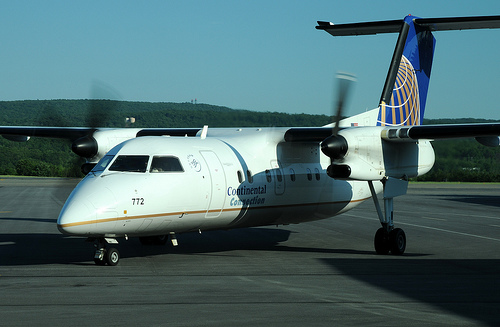
    dash-8The tragic accident of the Continental Airlines Dash 8 has generated a lot of speculation about the role of ice in the loss of control and subsequent crash of the aircraft. I am not going to suggest any cause of the accident as there are many knowledgeable people involved in the investigation that will come up with the answers.

    I would like to explain to those who are interested, why ice makes such a difference in the handling of the aircraft.  To understand the problem you have to have an idea of the theory of aircraft flight.

     The wings have a shape which produces lift as they travel through the air. However, they also produce drag and they have a weight that is a gravitational force.  The weight of the wing acts through the centre of gravity; this is the point that the wing would balance on if it were removed from the plane. The centre of lift is where all the lift forces could be measured and  opposes and is normally behind the center of gravity. Because it is behind the centre of gravity there is a twisting force to lower the front of the wing. If this were not opposed then the aircraft would not be able to fly.

    The tail is the place where the opposition is generated. The tail surfaces are designed to generate a downward force to oppose the twisting force of the wing and keep the aircraft level.  So, everything is in balance.  There are times when more lift is required, for the aircraft to take off or fly slower so it can land.  To achieve this flaps on the back of the wing can be lowered to increase the size of the wing and produce more lift.

    When the flaps are lowered the centre of lift moves rearwards and the twisting force of the wing increases, this is normally opposed by moving the trim on the tail to increase the opposition force and raise the nose. There is a range of trim available which is sufficient for normal operation.

    This is the way the aircraft is designed to operate. When ice collects on the wings it changes the shape of the wing so that some of the lift is lost, it also increases the weight of the wing which can move the center of gravity forward.  The build up of ice on the tail will add even more weight to the aircraft and reduce its ability to oppose the twisting force on the wing. The result is the same as lowering the flaps without the added lift that would be generated. The nose would be lowered and  the way to deal with this would be to trim the tail to increase the downward force.

    This is exactly what the autopilot does. As the ice builds up on the wings and tail the autopilot trims the tail to increase the downward force. This can be a very slow and insidious process as the autopilot will use more trim to keep the aircraft level. If the crew are not aware of the situation they may find that the trim limit has been reached before they  know they have a problem.  If they then change the status quo by lowering the landing gear or the flaps the auto pilot will be unable to trim the aircraft and will disengage leaving the crew with a very dangerous nose down attitude for which instant recognition of the problem and the correct response will be needed to avoid a loss of control.

    This situation is normally also at low altitude and airspeed and is very hazardous. Most operators regard icing very seriously and when in icing normally instruct the crew to fly the plane manually to make them aware at an early stage of the amount of trim they are using to control the attitude. They can then decide if they need to climb out of the icing conditions or take other action to avoid increasing ice build up. There are different systems on different aircraft which either prevent ice forming (anti-icing) or remove it as it forms (de-icing). De-icing that uses air to inflate boots to distort the leading edge of the wing and break up the ice which has formed was the system on the Dash 8 in Buffalo. This system requires the ice be allowed to build up to a certain thickness before the boots are inflated as thin ice will not break off. An automatic timer will inflate the boots periodically and there is a manual system if the automatic periods are too long.

    The tragic loss of the aircraft in Buffalo has brought the problem of icing into the spotlight but aircrews and airplanes have been dealing with it ever since flying began and there are many safeguards built into the system. I hope this has shed some insight on the hazards of ice on aircraft and the means to combat it.
  • Fly By Wire

    Well it looks like the science fiction is being overtaken by reality. Recently a Gulfstream 550 jet was controlled by a light signal from the cockpit to one of the flying controls. The controls of an aircraft are traditionally moved by the pilots commands being transmitted to the control via a stainless steel cable or aluminum rods. This also involves pulleys and bellcranks to move the cable in the correct direction. Then ‘fly by wire’ was developed which relies on electrical signals to move the control surfaces. This saved weight and allowed computers to control the aircraft without the traditional cables.

    Now we have a signal from the pilots controls changed into a light pulse which is transmitted via fiber optics to a receiver where it is converted back to an electrical signal to move the control. This saves even more weight and is a lot more reliable than an electrical wire which can short or break. There is no danger of losing the signal if even a fraction of the fiber optic cable is left intact after it has been damaged.

    If you think this is ground breaking then you will be amazed to learn that in the same experimental aircraft there was a ‘fly by wireless’ system operating as a back up which as the name suggests has no connection from the cockpit to the control except a radio signal. This has to be the ultimate in weight saving and reliability. When it is fully tested and approved it will be almost unheard of to lose control of the aircraft due to mechanical or hydraulic failure as the systems will not rely on them.

  • British Airways Boeing 777 Crash at Heathrow – Report

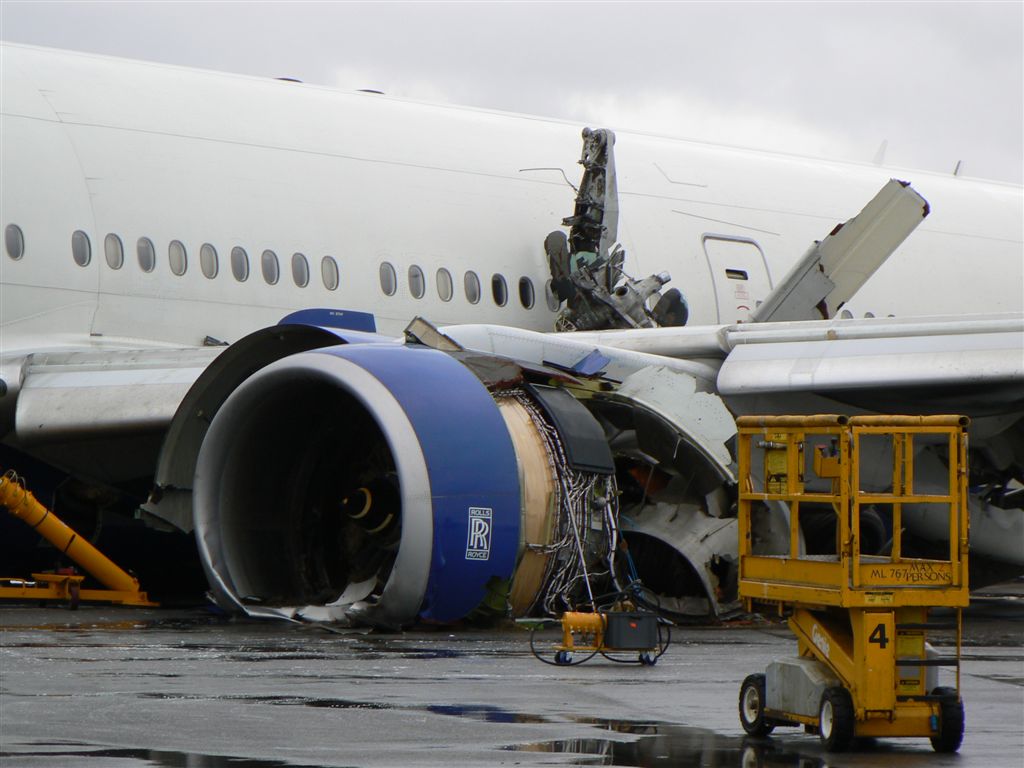
    Ice has always been the enemy of aircraft, it builds up on the wings and reduces lift and it lies on the runway and reduces braking and directional control when landing, but now there is a new hazard. After nine months of investigation the Air Accidents Investigation Branch (AAIB) have decided the cause of the British Airways Boeing 777 landing short at Heathrow and crashing was due to ice in the fuel. All the passengers and crew escaped the aircraft with only minor injuries apart from one man who broke his leg.

    It has been known for years that there is water in aviation fuel and when the temperature drops, due to the aircraft operating at altitude, ice crystals form in the fuel. There have been chemical and mechanical solutions to this problem and it is a largely unknown problem in large commercial aircraft.

    The fuel passing through a Trent 800 engine like the one that was powering the BA aircraft goes to an oil/fuel heater in the engine fuel system. This takes hot oil from the engine to a matrix of small pipes and passes fuel around the pipes on its way to the fuel control unit and the burners. This is normally sufficient to melt any ice that may be in the fuel so it will not interfere with the operation of the engine. The theory of the investigators is that ice formed before the engine oil/fuel heater and reduced the amount of fuel available for the engines to use.

    The High Pressure fuel pumps that are downstream of the oil/fuel heater showed evidence of cavitation. This is a condition that happens when the impellor of the pump has an insufficient fuel supply to boost to a higher pressure and mechanical damage is caused to the pumps. Clearly there was low fuel supply to the engines but where was the restriction? Because of filters, low-pressure pumps and valves that are all in the fuel supply system it has not yet been determined as to where the problem lies.

    Why it occurred is also a mystery as there has never been a case of fuel starvation due to icing in the fuel system of a commercial airliner. The Flight Data Recorder has shown that within 6 seconds both engines reduced power to a value below that needed to maintain flight and the automatic systems and the pilots took the required actions to supply more fuel but to no avail as it could not get to the High Pressure Pump.

    The low fuel flow at cruise power settings on an especially cold, long flight may have caused a build up of ice in an area in the fuel system which, with the high fuel demand in the landing phase of flight, detached from its location and caused the restriction. This theory has not yet been proven despite extensive and imaginative testing. The reason it is being put forward is every other scenario has been eliminated. As this is a preliminary report we will have to wait some time, maybe years, before the final report is issued and the cause is known. In the mean time the FAA and the manufacturers of the engine and aircraft are going to look at ways to mitigate the effects of long, cold flights on the fuel system.